Some Topics are Difficult
The one hundred most important pages I'll read this year

Some topics are difficult to write about. They’re too complex, too polarising or too emotional. Writing about Australia’s inability to stem violence against women and children is surely as tricky as topics get, yet Jess Hill’s ability to consistently do this - and do it well - is again on show in her Quarterly Essay ‘Losing It: Can we Stop Violence Against Women and Children?’ (Black Inc, 2025).
In this essay, Hill is able to contrast and synthesise available evidence, before comparing its relevance against prevailing theories of change. When the implementation of Changing the Story (the federal government’s primary prevention strategy) is analysed alongside the ongoing horrors in our communities, Hill wonders whether we’re on the right track: “By then (mid-2024) … Australia was having a long-overdue, albeit difficult, conversation about our violence-prevention strategy.”
The problem of domestic and family violence often sees brilliant practitioners and academics firmly wedded to either the feminist or the psychopathology model of violence. Yet, my training in community psychology has me wondering if violence can be caused by both the individual (the male perpetrator) and the macrosystem (societal problems such as gender inequality)? Couldn’t there also be drivers of violence (such as substance use, adverse childhood experiences, etc.) at every ecological layer in-between? Hill seems to call for balance, stating that “there is no doubt that gender inequality is both a cause and consequence of men’s violence against women and children.” Before reasserting that “there’s also no doubting the sincerity and determination of those trying to address this.”
I have worked alongside amazing peers who predominantly subscribe to either the individualistic, psychopathology model of family violence offending; or the feminist, gender-equality paradigm of violence prevention. Despite my utmost respect for these people, I sometimes find the sense of single-minded conviction from both camps confusing. I suspect that common ground will be increased between these perspectives over time. Each group makes valid points, and their arguments would make for a fascinating public debate if the stakes weren’t so high and the search for change so urgent.
Jess Hill’s work has garnered her status in our country, and when paired with her investigative journalism, she finds plenty of people willing to speak on and off the record. I was intrigued when reading about the interaction between alcohol, gambling and violence (“if alcohol has been the elephant in the room, gambling is barely allowed inside the house.”). Despite people from senior government positions sharing about infighting from Canberra, the essay made no further mention of lobbying from the gambling or alcohol industries that specifically undermined prevention efforts. Given the recent softening of the federal government’s positioning on gambling advertising, I remain sceptical about which commercial forces are negating meaningful reform. If rates of violence are through the roof when major sporting events are held, how can this matter not be met with the seriousness of life or death?
My recent engagement with this topic can been divided into two neat halves: four years of poring over the literature and trying to consider how a community psychology lens can link warring factions; then, four years in an intellectual fetal position, overwhelmed by this topic for professional and personal reasons. Ultimately though, all psychologists and community service workers are required to work with domestic and family violence, whether it’s their specialty or not. We can’t simply ‘opt out’ of this work, and many times when we are anticipating lighter sessions we are visited by this topic.
Last year I had the opportunity to teach a Health and Community Psychology Unit to Postgraduate students, and the syllabus of this course included three hours on Family Violence. To facilitate this session well, I had little option but to seek clinical supervision, grit my teeth, and re-engage with the topic in a meaningful way. I am grateful for this experience. On one hand, psychologists should not stray beyond their specific areas of competence, and on the other hand, I don’t want to forever remain a passive onlooker for something so important.
Time and again I continue to experience a familiar uneasiness when engaging with this topic. A pit in my stomach re-opens when I step away from engaging with the abstract theory of this work, and back into the terrible mess of formulating my role in practical change. Across the last week I’ve had this dilemma front-of-mind in many idle moments. Should I take my children to a march to demand an end to violence against women? Should I donate somewhere? Ultimately, I’ve opted to integrate Hill’s work into my existing practice as a therapist, supervisor and academic. Her reference list is a treasure trove that will inform my teaching for the rest of this year and beyond. Her case studies will support me to notice (and hopefully thwart) the myriad ways that psychologists can cause unintentional harm to survivors of violence.
I offer my personal and professional perspective as background to an opinion that Jess Hill deserves every accolade that comes her way. Her journalistic dexterity, to capture the history of this topic, and zoom in and out from the personal to the universal, is quite an achievement. At one point she asks the reader to put their policy gumboots on, before distilling dry government text into a highly readable summary. Many psychs I know are too busy to engage with policy documents, and Hill’s legwork in collating this section is just one reason why the one-hundred pages of this essay are vital reading for my colleagues.
Hill’s final pages are devoted to exploring the ills of our various child protection systems, again with her analysis documenting individual stories and broadening them out to policy failures. It’s easy to label this system as broken (and I often do), but systems aren’t just flow charts of arrows and shapes. In practice, they’re collections of humans. I believe that Australia’s child protection services can be improved if we intentionally tackle factors that are exacerbating burnout and contributing to an outrageous turnover rate of staff. How can the children forced into these systems be expected to heal if they’re not offered consistent or predictable support? As well as reforming overall models of care, we must find a way to keep compassionate and smart employees in the sector.
Some topics are difficult to write about. This piece is several hundred words long because I couldn’t find a succinct phrase worthy of encouraging my peers to read the essay. I have edited and fretted over my language here in a careful manner, mindful of not having topic-specific or lived-experience expertise to offer you. In short, I want to share how useful Hill’s essay might be for your practice.
Given entrenched divisions within the sector, often between brilliant people, I suspect that Hill’s work will again be met with critiques. Some topics are difficult, but for someone with my broad, generalist understanding of this tricky space, I think these hundred pages of Hill’s essay may well be the most important I read this year. As she writes: “The stakes could not be higher – which is why we need to have an honest debate about what’s working and what’s not.”
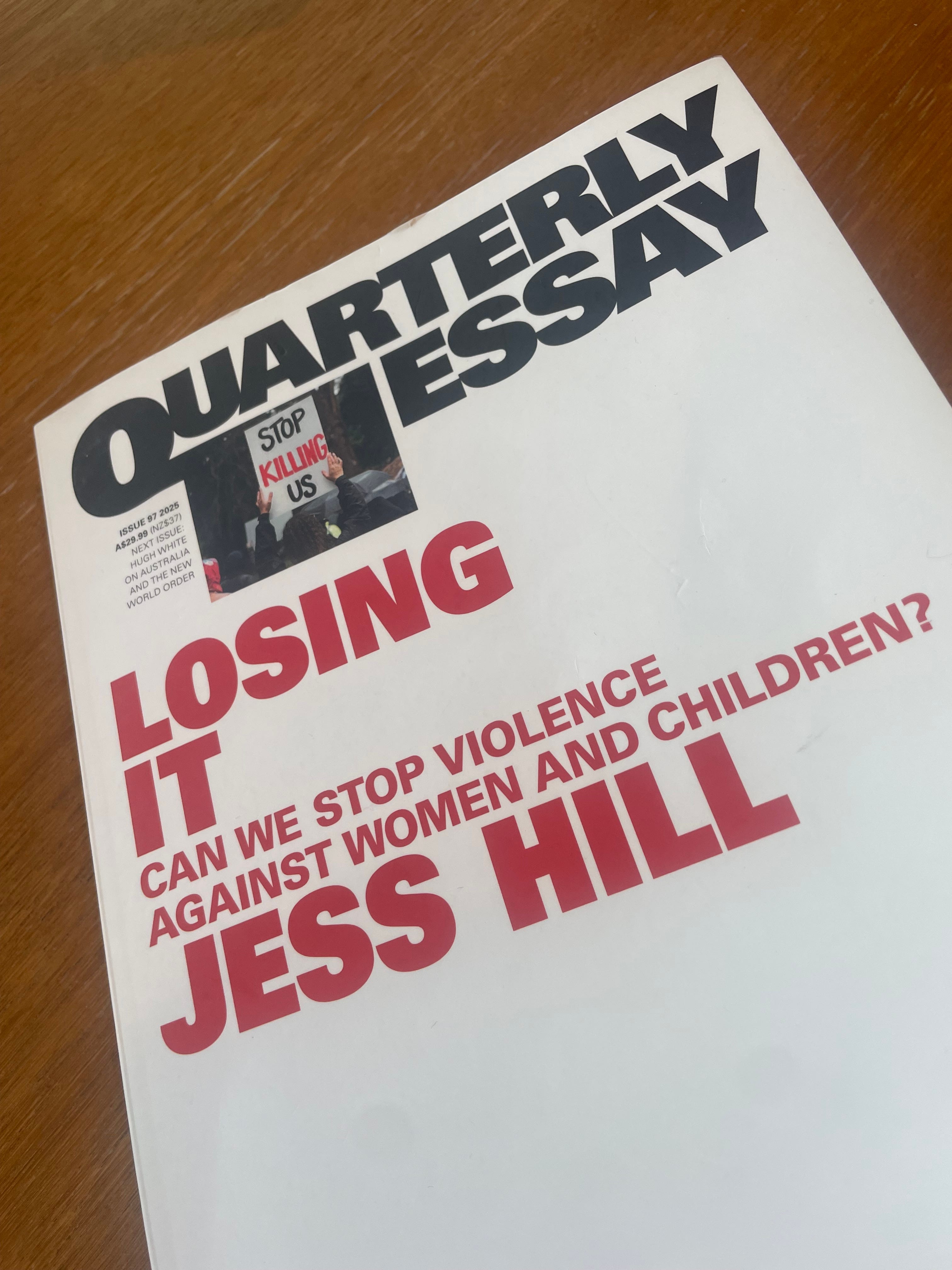
Hill, J. (2025). Losing It: Can we Stop Violence Against Women and Children? Quarterly Essay, (97), 1-121. Black Inc.
Great analysis Shane!